
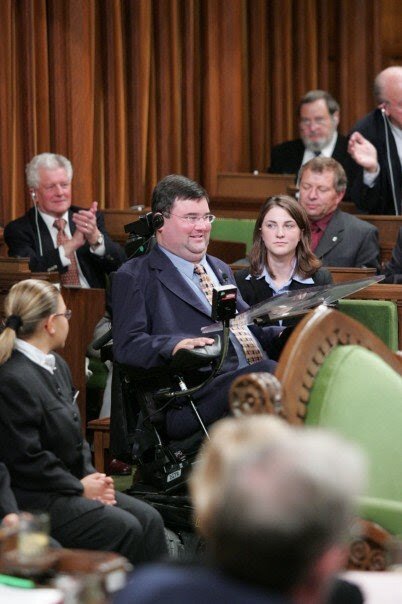
Official Opposition Health Critic
Elected in June 2004, Steven Fletcher entered a minority Parliament as the Conservative Party’s health critic. It was the term that produced the most directly documented result of his career: the extension of hepatitis C compensation to victims the earlier settlement had left out.
A minority Parliament
Fletcher was elected Member of Parliament for Charleswood, St. James and Assiniboia in June 2004 and was named the Conservative Party’s health critic. The role put him in Question Period, on the Standing Committee on Health, and behind opposition day motions and petitions.
The minority context mattered. Opposition parties could combine to carry motions and committee reports, which gave a determined critic real procedural leverage. Fletcher used it.
Hepatitis C compensation
Thousands of Canadians were infected through the blood system before 1986 or after July 1990, and the earlier federal compensation arrangements covered only those infected between those dates. Fletcher argued the cut-off was arbitrary and inconsistent with the moral conclusions of the Krever Inquiry.
He raised it almost immediately. On October 22, 2004 he challenged the government over the roughly $1.1 billion sitting in the compensation fund, and the administrative cost of holding it, while people outside the window received nothing.1 On February 16, 2005 he returned to it in an adjournment debate, criticising the government for failing to answer the question at all.2
The Standing Committee on Health reported in favour of extending compensation. Fletcher moved concurrence in the committee’s seventh report and the House agreed.3
The outcome is unusually well documented. When Prime Minister Stephen Harper announced the compensation initiative on July 25, 2006, he thanked Fletcher by name, saying he had “championed equal compensation since his arrival in Ottawa in 2004.”4 The settlement itself required victims’ organisations, counsel, officials, the Minister of Health, cabinet and court approval. What the record supports is that Fletcher was one of its leading parliamentary advocates, and that the Prime Minister said so publicly when the government acted.
The Canadian Strategy for Cancer Control
Fletcher’s cancer work came to a head in a Conservative opposition day motion on June 7, 2005 calling on the government to fully implement and fund the Canadian Strategy for Cancer Control. It was debated through the day and adopted by the House.5 The next day he pressed the government on what the vote meant in money, putting the figure at $260 million over five years.6
He kept at it. In October 2005 he told the House that Canada lagged other developed countries in cancer control.7 In a November adjournment debate he argued that the cancer community wanted full implementation and rejected the framing of cancer as simply a chronic disease.8
In November 2006 the government announced the Canadian Partnership Against Cancer with $260 million over five years. The motion and the sustained advocacy behind it formed part of the parliamentary and public pressure that led there. The institution itself was a government decision built on years of work by the cancer control community.
Autism
Before entering government Fletcher presented petitions asking that Applied Behavioural Analysis and Intensive Behavioural Intervention be treated as medically necessary. He later supported the national strategy approach in Motion M-172, arguing for federal leadership on surveillance, research and evidence based diagnostic standards, delivered through cooperation with the provinces. During debate on Bill C-304 in December 2006 he supported helping families but argued that amending the Canada Health Act was the wrong mechanism, because delivery of treatment falls largely within provincial jurisdiction.9
The objective stayed constant while the mechanism evolved: federal leadership and research, through federal and provincial cooperation rather than a unilateral redefinition of insured services.
Trans fats, wait times and the health workforce
Fletcher supported the cross-party parliamentary effort to reduce industrially produced trans fats in the food supply. The principal private member’s initiative is generally associated with Winnipeg MP Pat Martin. The sequence that followed, a House motion, a federal task force, voluntary targets, monitoring and eventually the prohibition of partially hydrogenated oils, ran on well past this Parliament. Fletcher’s part was helping build the parliamentary momentum behind it.
He also pressed the government on doctor and specialist shortages, delays in recognising internationally trained professionals, whether governments were meeting the wait time benchmarks in the 2004 health accord, the transparency of federal health spending, and the case for catastrophic prescription drug protection so that serious illness would not mean financial ruin. These were areas of sustained scrutiny rather than files with a single attributable outcome.
The wider opposition record took in cross-border internet pharmacies, the federal medicinal marijuana operation near Flin Flon, diabetes and prostate cancer strategies, public health preparedness, and a humanitarian petition concerning children affected by the conflict in northern Uganda.
Sources
- Official Hansard, October 22, 2004. ourcommons.ca
- Official Hansard, February 16, 2005. ourcommons.ca
- 38th Parliament Hansard index. ourcommons.ca
- Address by the Prime Minister announcing compensation for hepatitis C victims, July 25, 2006. canada.ca
- Official Hansard, June 7, 2005. ourcommons.ca
- Official Hansard, June 8, 2005. ourcommons.ca
- Official Hansard, October 26, 2005. ourcommons.ca
- Official Hansard, November 16, 2005. ourcommons.ca
- Official Hansard, December 7, 2006. ourcommons.ca