
Treasury Board and the assisted dying bills
Leaving cabinet in July 2013 gave Fletcher more freedom than he had held in nine years, and he used it on the one issue where he was prepared to break from his own government. He introduced a full legislative framework for physician assisted death eleven months before the Supreme Court made parliamentary action unavoidable.
Out of cabinet, still on Treasury Board
Prime Minister Harper removed Fletcher from cabinet in the broad shuffle of July 15, 2013, presented at the time as a renewal of the ministry. No formal reason was recorded for any individual removal, so later explanations are interpretation rather than established fact. Maclean’s profiled the greater latitude available to him afterwards.1
He remained a Conservative MP and continued to serve on Treasury Board. He did not become a rebel. He supported the government on economic policy, criminal justice, trade, electoral legislation and regulatory reform. His independence showed on one file, and it was the one where the government had no policy supporting legalisation.
Bills C-581 and C-582
Fletcher began publicly calling for a parliamentary debate on assisted death in 2013. It was an unusual position for a Conservative MP, and a pointed one, because some disability organisations argued that legalisation would devalue and endanger disabled people. His answer rested on autonomy and on the distinction between disability and intolerable suffering: recognising a choice for competent adults in defined circumstances did not diminish the value of his life or anyone else’s.
On March 27, 2014 he introduced two companion private members’ bills. Bill C-581 proposed Criminal Code amendments permitting physician assisted death within a regulated framework, and at first reading he described its dual purpose as empowering competent adults to decide for themselves while protecting vulnerable people.2 It went well beyond removing an offence, attempting to define eligibility, consent, medical participation, documentation and safeguards.
The companion Bill C-582 proposed a federal commission to collect and report information on assisted deaths, including demographic and medical data. His argument was that a legal regime without reliable national data could not be evaluated for safety, consistency, access or unintended effects.3 The two bill structure anticipated a central feature of the law Canada eventually adopted: substantive eligibility and safeguards, paired with federal monitoring and reporting.
Neither bill reached second reading before the Parliament ended, partly through the lottery and scheduling system for private members’ business and partly through the reluctance of party leaderships to touch the issue before the courts ruled. What Fletcher did was produce and introduce a serious parliamentary framework before the Supreme Court required one.
The debate
The bills drew national coverage.4 Supporters saw a principled conservative case for personal autonomy and limited government. Critics, including disability rights advocates, warned about coercion, inadequate care, social devaluation and the risk that apparent choice could be shaped by poverty or lack of support.
Fletcher rejected the argument that permitting assisted death necessarily diminished disabled lives. A federal media review later recorded his position that his own life would not be devalued because suffering was reduced elsewhere.5 He also supported palliative care, and did not present assisted death as a substitute for good end-of- life services. He argued Canada needed both.
Carter
On February 6, 2015 the Supreme Court of Canada decided Carter v. Canada (Attorney General) unanimously, holding that the absolute criminal prohibition unjustifiably infringed the Charter rights of competent adults who clearly consented to ending life and had a grievous and irremediable medical condition causing enduring and intolerable suffering.
Fletcher welcomed the judgment and pressed Parliament to respond rather than wait. On February 17 he called it a historic decision supported by the vast majority of Canadians.6 On February 24 he sought and received unanimous consent to table the decision in both official languages, and encouraged Canadians to read it.7 On May 5 he gave a longer and deliberately funny speech designed to make death discussable rather than abstract. The point underneath was direct: death is universal, prolonged suffering is real, and policy should not push competent people into premature suicide out of fear that they will later lose the physical capacity to act.8
There are clear conceptual similarities between his bills and the federal regime that followed, particularly on competent consent, grievous medical circumstances, safeguards, data collection and national oversight. The Harper government did not enact replacement legislation before the October 2015 election. Bill C-14 was passed in 2016, after Fletcher had left federal office.
Spinal cord injury and inclusion
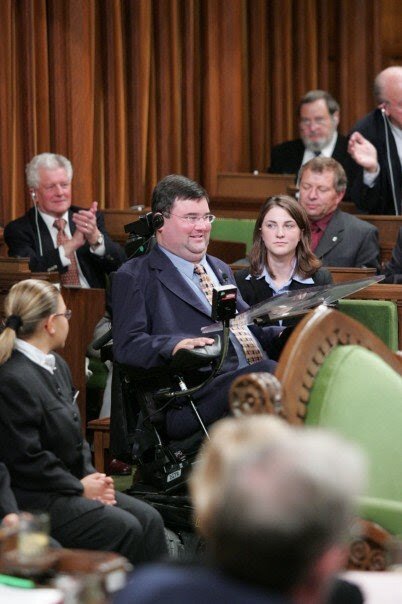
This period also brought a cross-party partnership with NDP MP Manon Perreault, who used a wheelchair following a spinal cord injury. Debating a national spinal cord injury awareness day in February 2015, Fletcher noted the progress represented by two MPs with spinal cord injuries while stressing how far Canada still had to go.9 In May 2015 he expanded on the practical barriers in transportation, buildings and supposedly accessible washrooms, describing the wheelchair awareness days he arranged for colleagues and how ordinary routines, coffee and the search for a washroom among them, expose failures that simulations miss.10 His substantive point was not an inspirational one. Exclusion is produced by systems, by transportation, architecture, washrooms, employment practice and social expectation, and systems are what have to change.
Health, regulation and public service
He kept up the positions he had defended as parliamentary secretary. In March 2015 he insisted on the term “supervised” rather than “safe” injection site, and asked whether proponents would accept such a facility in their own ridings.11 In November 2013 he opposed prison needle distribution proposals on grounds of illegality and institutional security.12
In September 2014 he drew explicitly on five or six years of Treasury Board experience while supporting legislation to entrench the one-for-one rule on regulatory burden, framing it as economic freedom for entrepreneurs.13 He also used Members’ Statements to mark Canadian public service: Dr. Frank Plummer, after fourteen years as scientific director of Winnipeg’s National Microbiology Laboratory, for his role in the H1N1 response and his globally important HIV research,14 and Cliff Chadderton, the decorated veteran and long-serving disability and veterans’ advocate.15
In March 2014 he asked what Parliament could be doing instead of consuming its time with partisan disputes, and answered that it should debate and pass laws that mattered to Canadians.16 The assisted death initiative was that view in practice. It was not government legislation, it did not help his career, and it exposed him to criticism from inside both the conservative and disability communities.
Master of My Fate and the 2015 election
In August 2015 Fletcher and Linda McIntosh released Master of My Fate, a sequel to What Do You Do If You Don’t Die?, covering his parliamentary and personal experience. It appeared during the election campaign. He said the timing was accidental, the product of publishing delay and an early call, but hoped it would push candidates and voters to discuss assisted death.17 Reaction was mixed. Some coverage read the book and the bills as a courageous attempt to raise an issue party leaders were avoiding; an iPolitics review considered it a missed opportunity.18
Redistribution had changed the riding to Charleswood, St. James, Assiniboia and Headingley. In the election of October 19, 2015, Liberal candidate Doug Eyolfson took 24,531 votes, or 52.0 percent, to Fletcher’s 18,408, or 39.0 percent, a margin of 6,123.19 It ended eleven years and four terms in the House of Commons, including roughly five years in cabinet, service as parliamentary secretary and long service on Treasury Board.
Sources
- Maclean’s, October 7, 2013. macleans.ca
- Official Hansard, March 27, 2014. ourcommons.ca
- Official Hansard, March 27, 2014. ourcommons.ca
- Maclean’s and Canadian Press profile. macleans.ca
- Department of Justice media review. justice.gc.ca
- Official Hansard, February 17, 2015. ourcommons.ca
- Official Hansard, February 24, 2015. ourcommons.ca
- Official Hansard, May 5, 2015. ourcommons.ca
- Official Hansard, February 25, 2015. ourcommons.ca
- Official Hansard, May 29, 2015. ourcommons.ca
- Official Hansard, March 13, 2015. ourcommons.ca
- Official Hansard, November 18, 2013. ourcommons.ca
- Official Hansard, September 15, 2014. ourcommons.ca
- Official Hansard, May 12, 2014. ourcommons.ca
- Official Hansard, December 2, 2013. ourcommons.ca
- Official Hansard, March 3, 2014. ourcommons.ca
- Winnipeg Free Press, August 28, 2015 winnipegfreepress.com, and Canadian Press via Global News globalnews.ca Source 1 Source 2
- iPolitics review, August 27, 2015. ipolitics.ca
- Elections Canada official results, 2015. elections.ca