
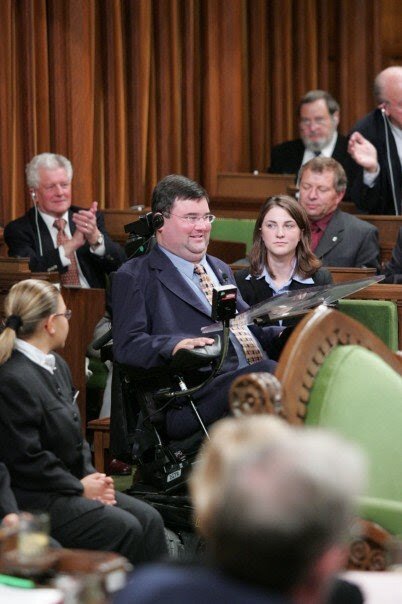
Minister of State for Democratic Reform
Appointed to cabinet on October 30, 2008, Fletcher took on a portfolio of constitutional and electoral files in a minority Parliament. He introduced a substantial legislative agenda on the Senate, representation, political loans and voting. Most of it did not survive the Parliament, which is its own lesson about how minority government works.
Cabinet
Fletcher was appointed Minister of State for Democratic Reform on October 30, 2008. His parliamentary profile records the appointment and his other roles.1 He also served on the Treasury Board, the government’s statutory management and expenditure board, which reviews departmental spending plans, program authorities, regulations and value for money.2
Senate reform
Fletcher carried the government’s case for limiting the terms of newly appointed senators and for a process allowing provinces to consult voters on preferred Senate nominees. On May 28, 2009 he announced legislation to establish term limits for new senators.3
His argument was that an appointment potentially running from age 30 to 75 was out of step with contemporary democratic expectations, and that an eight year non-renewable term was a meaningful reform achievable within the constitutional framework. The bills did not produce a term limited or elected Senate. Constitutional uncertainty persisted, and the Supreme Court’s 2014 Senate Reference later held that major changes require substantial provincial consent. What the record supports is that Fletcher led the federal government’s Senate reform legislative agenda.
Representation in the House of Commons
He advanced bills responding to rapid population growth in Ontario, Alberta and British Columbia while protecting the representation of smaller provinces and of Quebec within the constitutional structure. On April 1, 2010 he introduced a democratic representation bill.4 His position was that voters in fast growing provinces should not be substantially under-represented, and that the less populous provinces should keep their constitutionally protected seats.
The Fair Representation Act was enacted in 2011, after Fletcher had moved to Transport, and was carried by his successor Tim Uppal. Fletcher’s contribution was developing and advancing the predecessor proposals.
Political loans, ethics and voting
On April 28, 2009 he announced legislation to tighten Canada Elections Act rules on political loans, to stop loans functioning as contributions that bypassed donation limits and disclosure.5 On May 7, 2009 he introduced legislation to put ethics administration for the House and Senate under a single commissioner.6 In June 2009 he introduced the Expanded Voting Opportunities Bill, proposing additional advance polling, an approach to turnout built on convenience and access rather than compulsory voting or wholesale electoral change.7
A pattern runs through the portfolio. The bills were produced and introduced. Minority Parliament dynamics, dissolution and prorogation repeatedly stopped them before enactment.
A Canadian democracy promotion agency
The 2008 Conservative platform and Speech from the Throne promised a non-partisan institution to help emerging democracies build political institutions, and Fletcher was given the job of developing it. He looked at the United Kingdom’s Westminster Foundation for Democracy, the United States National Endowment for Democracy and its party institutes, and European multiparty institutes. The Canadian model was intended to be arm’s length, multiparty, and focused on political party and parliamentary development.
An advisory panel chaired by Thomas Axworthy recommended a Canadian Centre for Advancing Democracy. Fletcher tabled the panel’s report in the House on November 23, 2009.8 The institution was never created. What the record supports is that he led the policy development and advisory process behind the proposal.
Disability policy
Democratic Reform was the formal portfolio, but Fletcher stayed a visible advocate for disability inclusion, appearing with Prime Minister Harper and Rick Hansen at events promoting the Registered Disability Savings Plan, the Enabling Accessibility Fund and accessible housing. In October 2009 the Prime Minister publicly described him as a passionate advocate for Canadians with disabilities.9
The RDSP was a significant piece of Canadian social policy innovation, and it took years of advocacy by PLAN, families, officials and Finance Minister Jim Flaherty among others. Fletcher’s contribution was internal and public advocacy.
Treasury Board and the financial crisis
Fletcher’s Treasury Board service covered the 2008 and 2009 global financial crisis and the Economic Action Plan. Treasury Board work is collective and confidential, so his membership and the scale of the period are the verifiable facts.10 Through the same years he continued announcing infrastructure, university, tourism, accessibility, science, health research and community projects in Manitoba.
Sources
- ParlInfo profile, Steven Fletcher. lop.parl.ca
- The Business of the Treasury Board, Treasury Board of Canada Secretariat. canada.ca
- Canada’s government moves forward with Senate reform, May 2009. canada.ca
- Official Hansard, April 1, 2010. ourcommons.ca
- Government introduces legislation to strengthen accountability for political loans, April 2009. canada.ca
- Government takes step to strengthen ethical standards in Parliament, May 2009. canada.ca
- Government introduces Expanded Voting Opportunities Bill, June 2009. canada.ca
- Official House record, November 23, 2009. publications.gc.ca
- Prime Minister’s remarks with Rick Hansen on government action for disabled Canadians, October 29, 2009. canada.ca
- The Business of the Treasury Board, Treasury Board of Canada Secretariat. canada.ca