
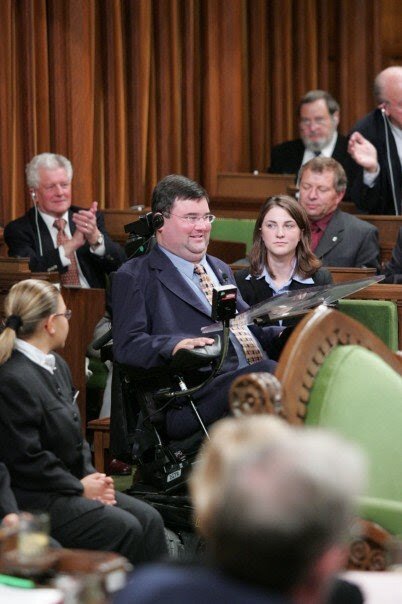
Parliamentary Secretary to the Minister of Health
In February 2006 Fletcher moved from scrutinising health policy to helping deliver it. The term saw the hepatitis C settlement he had pushed for in opposition, and his sustained work on Jordan’s Principle, the child first rule named for a boy from Norway House Cree Nation.
Appointment
On February 7, 2006 Prime Minister Harper appointed Fletcher Parliamentary Secretary to the Minister of Health, and to the minister responsible for the Federal Economic Development Initiative for Northern Ontario.1 The job was to support Health Minister Tony Clement: answering in the House, appearing in committee, explaining policy and making announcements.
Delivering hepatitis C compensation
The new government opened negotiations covering the pre-1986 and post-1990 class. Fletcher told the House in May 2006 that it was a top priority and that talks were under way. The July 2006 announcement and the settlement that followed committed approximately $1 billion through court supervised processes, and the Prime Minister credited Fletcher’s advocacy directly in announcing it.2
The continuity is the point. He pressed the case in opposition, the House endorsed extending compensation, he became parliamentary secretary to the responsible minister, and the government moved to settle.
Cancer and mental health
The Canadian Partnership Against Cancer was announced in November 2006 with $260 million over five years. Fletcher continued to speak on prevention, survival, research and coordination, including a House statement marking National Cancer Survivors Day in June 2007.3
In October 2006 he officially welcomed The Human Face of Mental Health and Mental Illness in Canada, arguing that better evidence was the route to reducing stigma and guiding policy.4 The Mental Health Commission of Canada was established in 2007, following the Senate committee work led by Michael Kirby and Wilbert Keon. Fletcher was a persistent parliamentary advocate for national mental health action and an early supporter of the Commission, alongside the Senate committee, mental health organisations, the Minister of Health and other parliamentarians.
Jordan’s Principle
Jordan’s Principle is named for Jordan River Anderson of Norway House Cree Nation in Manitoba. Its rule is simple: a First Nations child receives the service they need first, and governments settle the jurisdictional argument afterwards.
Fletcher engaged with it early. On June 6, 2007 he told the House he had introduced a motion called Jordan’s Principle, describing it as a way past jurisdictional disputes and a way of putting children first.5 On October 31, 2007, during debate on Jean Crowder’s Motion M-296, he said he fully supported the motion’s intent, explained how administrative and funding procedures can end up subordinating the interests of the child, and cited the August 2007 Canadian Medical Association Journal editorial “Jordan’s Principle, governments’ paralysis.”6 On December 7, 2007 he returned to Jordan’s case and the harm done when governments argue over responsibility while a child stays in hospital.7
The House endorsed Jordan’s Principle unanimously in December 2007. Fletcher’s record here is not simply a vote for a consensus motion. He researched the issue, spoke for the child first rule, connected it to Manitoba and named the precise administrative failure it was meant to correct. The implementation history that followed was contentious and narrower than advocates wanted, across successive governments.
Supervised injection and drug policy
Through 2007 and 2008 Fletcher defended the government’s cautious approach to the section 56 exemption for Vancouver’s supervised injection facility, emphasising research, treatment, prevention and enforcement, and arguing that many of the health services offered at the site could continue independently of an exemption permitting possession and consumption of illegal drugs. The file was contested, and the litigation that followed ended in the Supreme Court’s 2011 decision in PHS Community Services Society, which rejected the federal refusal to extend the exemption on the facts before the Court.
Accessibility and the operation of Parliament
Fletcher’s presence changed how the House physically worked, including the accommodation of his wheelchair position and the presence of an attendant on the chamber floor. He also used the platform for practical questions, among them the availability of wheelchair accessible taxis in Ottawa. In 2008 he travelled to Canadian Forces Station Alert, which demonstrated both personal determination and the capacity of federal institutions to accommodate a person with a high level disability in an extremely remote setting.
Sources
- Prime Minister announces parliamentary secretaries, February 2006. canada.ca
- Address by the Prime Minister announcing compensation for hepatitis C victims, July 25, 2006. canada.ca
- Official Hansard, June 4, 2007. ourcommons.ca
- Steven Fletcher welcomes report on mental illness in Canada, October 2006. canada.ca
- Official Hansard, June 6, 2007. ourcommons.ca
- Official Hansard, October 31, 2007. ourcommons.ca
- Official Hansard, December 7, 2007. ourcommons.ca